 Nederlands
 English
 Deutsch
Bike barrier
A bicycle barrier will be familiar to you from the Flemish streetscape: the low fencing used at events to guide cyclists and provide a temporary place to park bicycles. We deploy bicycle barriers as part of complete bicycle parking solutions at events in Belgium and the Netherlands: guiding visitors towards the parking area, separating cyclists from pedestrians and traffic, and providing the parking facility itself.
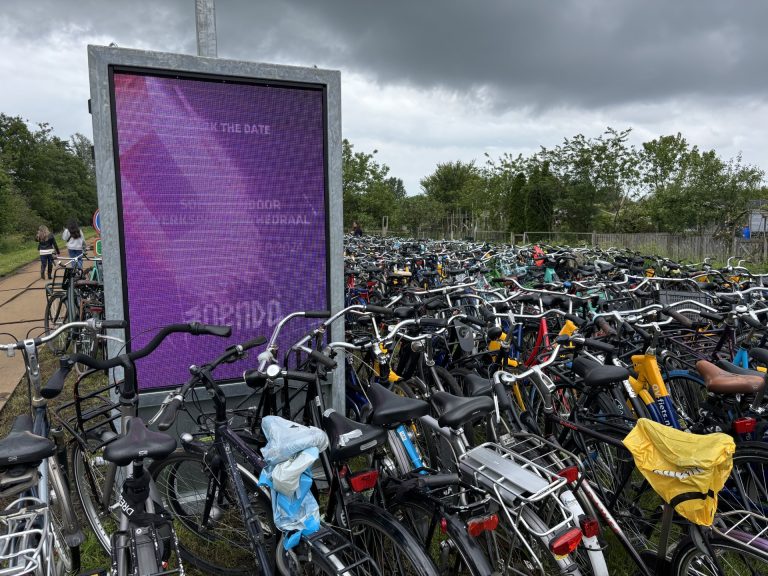
What is a bicycle rack barrier?
Fietsnadar is the Flemish term for a portable barrier system used at events to manage bicycle traffic. The name derives from the classic nadar barrier, the Belgian crowd-control fence, but in its cycling application the barrier serves two purposes simultaneously: it guides cyclists along a clearly defined route, and it provides a place where bicycles can be temporarily parked against or alongside it. In the Netherlands, virtually the same piece of street furniture is called a fietshek or, in its fixed form, a fietsnietje. Whether you search for fietsnadar, fietsnader or nadarhek voor fietsen, everyone means the same thing: low, interlocking barriers that direct bicycle traffic and offer cyclists a temporary place to leave their bike.
At events, that dual function is precisely what is needed. Thousands of cyclists arrive via the same access routes and must be guided to the bicycle parking area without conflict with pedestrians or vehicles. A row of fietsnadars makes that route physically visible: cyclists naturally follow the barrier, and the flow of traffic arrives exactly where it should. Once at the parking area, bicycles are stored in the racks, while the barriers keep the perimeter of the site neat and orderly, even at the busiest moments.
A fietsnadar is emphatically not the same as a standard crowd-control barrier for managing visitor flows. It is specifically a cycling application: route guidance and temporary bicycle parking, always as an integral part of the bicycle parking infrastructure at your event.
Bicycle barrier hire for your event in Belgium or the Netherlands
We do not supply bicycle nadars as standalone fencing, but as part of a complete cycle parking solution for your event. In practice, this means the parking facility itself consists of our racks, while the nadars form the approach routes, the separations, and where necessary additional parking borders for peak demand. That combination ensures the entire cycling journey works seamlessly, from the access road to the rack.
For clients in Flanders, this is a familiar sight. From village races to festivals, nadars are widely used in Belgium to channel bicycle flows, and that approach aligns perfectly with ours. Our service area covers the whole of Belgium, as well as the Netherlands and Germany, and we deliver using our own transport in full compliance with current European regulations.
The planning principles are the same as for our parking facilities: send us your site plan and your expected visitor numbers, and we will map out the routes and the parking layout. You can read more about how the full hire process works at fietsenrek huren and at fietsenstalling huren.
Quantities scale with the size of your event. For a village race, a few dozen metres of guidance fencing at the start and finish is sufficient; a multi-day festival calls for routes from multiple access points plus parking borders around thousands of rack spaces. Because nadars, racks, and services all come from a single supplier, any change to the programme never becomes a coordination problem between multiple parties.
Guidance that makes the parking work
A bicycle parking area only works if visitors can find it and actually use it. That is where the real value of bicycle crowd control barriers lies: they transform the parking area from a destination into a route. The setup begins on the approach, where barriers and signage guide cyclists away from motor traffic. The route then narrows towards the entrance of the parking area, so that the flow arrives calmly and in a controlled manner rather than all at once.
At the end of the event, the same principle works in reverse. The peak moment after closing, when everyone departs simultaneously, calls for wide, clearly demarcated exit routes that keep pedestrians and cyclists separated. Barriers create that separation physically, and stewards provide guidance where needed. This keeps even the busiest quarter of an hour manageable, and ensures no one ends up stuck walking their bicycle through a stream of pedestrians.
For the safety coordinator and the local authority, this approach is invaluable. An increasing number of permits require a fully developed mobility plan, and a site map showing routes, barriers and parking capacity answers that requirement concretely. We supply the data you need for this purpose.
Do not underestimate the impact on the surrounding area either. An event where cyclists scatter across pavements and car parks generates complaints from local residents and businesses. A bicycle barrier route keeps the flow where it is intended to be, and that makes a real difference the following day, both in the organisation’s inbox and in conversations with the local authority about the next edition.
Bike barrier, bike stand or bicycle rack: which do you choose?
The three terms are often used interchangeably in practice, so here is a straightforward breakdown:
- the bicycle rack is the parking structure itself: 20 bicycles per three-metre section, used when numbers matter
- the bicycle staple is the fixed hoop for permanent locations in public spaces
- the bicycle barrier is the movable fence used for route guidance and flexible parking edges at events
For an event, you will typically combine all three: racks for the bulk of bicycles, barriers for routing and flexible perimeter management, and at the VIP entrance perhaps bicycle decking or staples for a neat presentation. For a permanent location without the dynamics of an event, you are better served by bicycle staples or a purchased bicycle parking solution.
Not sure what your situation requires? Describe the event and the location, and we will advise on the combination that best suits your needs. You do not need to master the terminology, that is our job. And if your safety plan or specification uses a different term, such as bicycle fence or guide fence, we will know exactly what is meant and provide a quote based on the function rather than the wording.
From floor plan to cleared site
The process is the same as with all our rentals. You request a quote with the date, location and expected number of cyclists. If you do not yet know those numbers precisely, we will advise you based on your visitor expectations and comparable events. We respond with a plan: the parking layout, the routes, the number of crowd barriers and racks, and a single all-inclusive price covering transport, installation and removal. No hidden costs, and the proposal commits you to nothing.
On the day itself, everything is in place before the first cyclist arrives. Our staff know the rhythm of event sites and work around your schedule, including overnight if the site needs to be clear by the following morning. During the event, there is one telephone number for on-the-spot adjustments, for instance if a route needs to run differently from the original plan.
Afterwards, we collect everything and leave the site exactly as we found it. For recurring events, we retain the site map and the figures, so that the next edition can be arranged with a single phone call. This turns cycle traffic management into a fixed, well-organised chapter in your event manual rather than an annual puzzle.
And if anything changes in the meantime, a new entrance, a relocated camping area, a revised diversion route from the local authority, we simply redraw the routes. The crowd barriers can be repositioned within an hour; that is precisely what they are designed for. The plan follows the event, never the other way around.
Where we take care of everything for you
Frequently asked questions about bicycle barriers
What is a fietsnadar?
Do you also hire out individual crowd-control barriers?
Do you also deliver in Belgium?
What is the difference between a fietsnadar and a fietsnietje?
What does it cost to hire a fietsnadar?
Request a quote today for your event
Would you like to hire a bicycle barrier as part of the cycle parking at your event in Belgium or the Netherlands? Call us or request a quote with the date, location and expected numbers. You will receive a complete plan including routes, parking and a single price, and on the day itself everything will be set up exactly as agreed.